
Kaohsiung has a way of surprising you. Most travelers arrive in Taiwan, spend the bulk of their time in Taipei, maybe squeeze in a day in Tainan, and then board their flight home without ever giving Taiwan’s second largest city its proper moment. And that is a genuine shame because Kaohsiung is bold, beautiful, and unlike anywhere else on the island.
This is a port city with salt air in its bones, a waterfront transformed into one of the most dynamic creative districts in Asia, Buddhist landmarks that will stop you in your tracks, and a night market scene that hits differently under the warm, year-round southern Taiwan sunshine.
As a Filipino traveler, Kaohsiung felt immediately comfortable. It has tropical in its energy, generous with its food, and endlessly welcoming in a way that big cities often forget to be. If you are building your Taiwan itinerary and wondering whether to include it, the answer is yes. Here are the top tourist spots in Kaohsiung that belong on your list right now.
1. Fo Guang Shan Monastery and Buddha Museum
.jpg)
Address: No. 1, Fo Guang Shan Road, Dashu District, Kaohsiung City 840
About an hour east of the city center in Dashu District, Fo Guang Shan is the largest Buddhist monastery in Taiwan and one of the most significant Buddhist landmarks in all of Asia. Founded in 1967, the complex follows the principles of Humanistic Buddhism and is built on a genuinely grand scale. It has eight symmetrical golden pagodas line a sweeping boulevard leading toward a towering 108-meter bronze seated Buddha, the largest seated Sakyamuni Buddha statue in Asia, rising above the hillside with a serene authority you feel even from a distance. The adjacent Fo Guang Shan Buddha Museum houses sacred Buddhist relics, beautifully designed exhibition halls, and tranquil reflection spaces that invite you to slow completely down. Even if you have no religious connection, the sheer architectural ambition and spiritual atmosphere of this complex is deeply moving.
2. Lotus Pond and Dragon and Tiger Pagodas

Address: Liantan Road, Zuoying District, Kaohsiung City 813
Built in the 1950s on the edge of a scenic man-made lake in Zuoying District, Lotus Pond is one of the most instantly recognizable and photographed attractions in all of southern Taiwan. The lake is ringed by colorful temples and religious pavilions, but the undisputed stars of the scene are the twin Dragon and Tiger Pagodas: two seven-story towers painted in vivid greens, reds, and golds, their entire facades covered in intricate mythological scenes and deity figures.
To enter, you walk in through the open mouth of the dragon and exit through the tiger’s mouth, a tradition said to bring good luck and wash away bad fortune. The Spring and Autumn Pavilions nearby, connected to the shore by zigzag bridges, add even more visual drama to the lakeside panorama. The whole area is also beautiful at night when everything is lit up in glowing color, making it worth a visit both day and evening.
3. Pier 2 Art Center

Address: No. 1, Dayong Road, Yancheng District, Kaohsiung City 803
Pier 2 Art Center is the beating creative heart of Kaohsiung and one of the most dynamic waterfront arts districts in all of Taiwan. What was once a cluster of decommissioned shipping warehouses along Kaohsiung Harbor has been transformed into a sprawling open-air gallery, creative hub, boutique shopping destination, and outdoor sculpture park that stretches along the harbor’s edge for a considerable distance. Every surface seems to be a canvas. It has giant murals, kinetic sculptures, interactive art installations, and whimsical metal figures populate every corner of the complex. Inside the converted warehouses, rotating exhibitions, artisan shops, indie cafes, and cultural events keep the space feeling alive and ever-changing. Take the Light Rail along the waterfront to explore the full length of the district, from the Kaohsiung Music Center in the north all the way down to the Hamasen area in the south.
4. Cijin Island (Qijin Island)

Address: Cijin District, Kaohsiung City 805 (ferry from Gushan Ferry Pier, No. 93, Binhai 1st Road, Gushan District)
Just a five-minute ferry ride from Gushan Pier, Cijin Island is Kaohsiung’s beloved island escape and one of the easiest and most rewarding half-day trips you can take from the city. This long, narrow island serves as a natural breakwater for Kaohsiung Port, and its car-free lanes, fresh seafood stalls, black sand beach, historic fort, and centuries-old lighthouse give it a completely different character from the urban city just across the water. Rent a bicycle or an electric rickshaw to explore the island at your own pace. You can cover the whole thing comfortably in a few hours. Do not miss the Rainbow Church, a striking rainbow-colored arch installation on the seaside that has become one of Kaohsiung’s most photographed spots. The Cihou Fort and the Kaohsiung Lighthouse at the northern tip are also worth the ride up.
5. Love River (Ai He)

Address: Love River runs through central Kaohsiung; main access points near Yanchengpu MRT Station (Orange Line) and City Council MRT Station
The Love River is Kaohsiung’s signature waterfront and one of the most pleasant urban waterways in all of Taiwan. Once a neglected and polluted industrial canal, the river has been beautifully restored and now flows through the heart of the city as a lush, landscaped ribbon of cafes, walking paths, cycling routes, public art, and romantic riverside scenery. By day it is a relaxed and lovely place to stroll or cycle, with tree-lined banks and small riverside restaurants to duck into. By evening, the whole strip transforms into something genuinely magical. The water reflects the lights of the city, boats cruise gently along the river, and live music drifts out from waterfront bars. An evening Love River cruise is highly recommended, with 20 to 30-minute boat rides gliding past illuminated bridges and the glowing silhouette of the Kaohsiung Music Center. This is Kaohsiung at its most romantic and most photogenic.
6. Dome of Light at Formosa Boulevard Station
.jpg)
Address: No. 115, Zhongshan 1st Road, Xinxing District, Kaohsiung City 800 (Formosa Boulevard MRT Station, Red and Orange Lines intersection)
The Dome of Light at Formosa Boulevard Station is the world’s largest glass artwork, and it is extraordinary. Created by Italian artist Narcissus Quagliata, this massive stained-glass installation covers the entire ceiling of the underground station’s central concourse in sweeping, brilliantly colored panels that depict the four elements: Water, Earth, Light, and Fire, along with themes of rebirth and the cycle of life. The colors shift and glow with the light throughout the day, and short light-and-sound shows run daily at 11am, 3pm, and 8pm, when the dome is illuminated from below in a choreographed display of color and music that genuinely takes your breath away. Best of all, entry is completely free. You just walk through the station to experience it.
7. Shoushan National Nature Park (Monkey Mountain)
-PeterWen-10.jpg)
Address: Shoushan District, Kaohsiung City 804 (main trailhead near Yuquan MRT Station or Neihui Trailhead off Shoushan Road)
Shoushan National Nature Park, affectionately called “Monkey Mountain,” is a forested range of hills that rises dramatically right along the western edge of Kaohsiung city, offering hiking trails, sweeping harbor views, and the memorable experience of sharing the mountain with hundreds of Formosan macaques who roam freely through the trees. The monkeys are bold, curious, and completely unbothered by human visitors keep your snacks tucked away and your bags closed, because they will absolutely help themselves if given the chance. The hike to the Shoushan LOVE Lookout, with its giant metal “LOVE” sculpture and panoramic view across the harbor, the port, and the city skyline, is one of the best and most rewarding free activities in all of Kaohsiung. The nearby Martyr’s Shrine, perched on the hillside just below the lookout, is an added historical bonus.
8. Sizihwan Bay (Xizi Bay)

Address: Sizihwan Road, Gushan District, Kaohsiung City 804 (accessible via MRT to Sizihwan Station, Orange Line)
Sizihwan Bay is one of Kaohsiung’s most beloved natural and cultural treasures, a sweeping coastal bay at the foot of Shoushan Mountain where the city meets the sea in one of the most scenic settings in southern Taiwan. The bay area combines a peaceful seaside park with clear water, natural reef formations, and a sunset view that is consistently ranked among the best in the city. The star historical attraction here is the Former British Consulate at Takao, a beautifully preserved red-brick building from 1865 that sits on a hillside above the bay and is one of the oldest Western-style buildings remaining in Taiwan. The consulate’s hilltop garden and veranda offer stunning views of the harbor below and the Cijin Island coastline beyond. The beach area is popular for swimming, the reef for snorkeling, and the surrounding cafes for a slow afternoon with the sea breeze. This is exactly the kind of place where you sit down meaning to stay 30 minutes and end up staying three hours.
9. Sanfeng Temple (Sanfong Temple)
_-_img_02.jpg)
Address: No. 181, Sanfeng 2nd Street, Sanmin District, Kaohsiung City 807
Built over 300 years ago and painstakingly relocated brick by brick to its current site in the Sanmin District just a few decades ago, Sanfeng Temple is one of the most beautiful and architecturally elaborate temples in all of Taiwan. Dedicated to the Three Phoenix Deities, the temple’s exterior is a masterwork of traditional Taiwanese religious craftsmanship, every inch of the facade covered in intricate ceramic tilework, carved stone dragons, gilded woodwork, and celestial deity figures stacked in glorious detail across multiple rooflines. Step inside the main courtyard and look up at the canopy of hundreds of red lanterns strung overhead, it is one of the most spectacular interior views of any temple in the country. Climb to the second floor for the best vantage point looking down over the lantern-filled courtyard below. Unlike many of Kaohsiung’s more tourist-heavy temples, Sanfeng still feels genuinely lived in and spiritually active, with a steady flow of devoted worshippers throughout the day.
10. Liuhe Night Market

Address: Liuhe 2nd Road, Xinxing District, Kaohsiung City 800 (a short walk from Formosa Boulevard MRT Station)
Liuhe Night Market is the most famous and internationally recognized night market in Kaohsiung, and its central location, just a short walk from the Formosa Boulevard MRT Station, makes it the easiest first night market experience for visitors arriving in the city. The market runs down a pedestrianized stretch of Liuhe Road, with stalls lining both sides serving a concentrated and well-curated selection of Taiwanese street food classics: grilled seafood, papaya milk, oyster omelette, stinky tofu, dan bing egg pancakes, and Kaohsiung’s famous fresh fruit juices. It skews more tourist-friendly than some of the larger local markets, which means the stalls are spaced out and easier to navigate, English menus are more common, and the overall atmosphere is festive without being overwhelming.
11. Ruifeng Night Market

Address: No. 300, Nanping Road, Zuoying District, Kaohsiung City 813 (accessible via bus from Zuoying MRT Station)
If Liuhe is Kaohsiung’s tourist night market, then Ruifeng is the city’s soul. Tucked up in the Zuoying District a little further from the city center, Ruifeng is the night market that locals actually love and visit regularly, and the difference is immediately obvious from the moment you arrive. The scale is enormous, hundreds of stalls spread across a wide open area and the energy is authentically Taiwanese, with families, students, and couples all out in full force on weekend evenings. The food selection here is as diverse as any market in Taiwan, covering everything from grilled corn and scallion pancakes to handmade noodles, taro balls, pork knuckle rice, and fresh-squeezed juices. The prices are genuinely affordable, the portions are generous, and the atmosphere is vibrant without being performative. Plan to spend at least two hours here and arrive hungry, because you will want to try everything.
12. Kaohsiung Music Center

Address: No. 1, Pengwan Road, Lingya District, Kaohsiung City 802 (Light Rail: Kaohsiung Music Center Station)
The Kaohsiung Music Center, opened in 2021, is one of the most architecturally dramatic additions to Kaohsiung’s already impressive waterfront and a venue that has quickly become a landmark of the city in its own right. The complex consists of several distinctive structures along the harbor’s edge, including the striking coral-reef-inspired Live Warehouse, the sleek indoor concert hall, and the outdoor Amphitheater that hosts large-scale waterfront performances facing the open water of the port. At night, the buildings light up in spectacular fashion, reflecting across the harbor surface and making the entire waterfront glow. Even if you are not attending a performance, the complex and its surrounding public spaces are wonderful to explore in the evening. The Kaohsiung Music Center anchors the northern end of the Pier 2 district, making it a natural starting point for a waterfront stroll heading south.
13. Former British Consulate at Takao

Address: No. 20, Lianhai Road, Gushan District, Kaohsiung City 804 (near Sizihwan Bay, accessible via MRT Orange Line to Sizihwan Station)
Perched on a red-brick hilltop overlooking the entrance to Kaohsiung Harbor, the Former British Consulate at Takao is one of the oldest surviving Western colonial buildings in Taiwan, completed in 1865 during a period when Kaohsiung (then called Takao) was an important international trading port. The building’s elegant Victorian-era architecture, warm terracotta brickwork, and arched colonnades give it a distinctly Mediterranean character that feels pleasantly out of place against the backdrop of southern Taiwan’s coastal scenery. The consulate grounds have been restored as a heritage museum and café, with the hilltop garden and veranda offering some of the most spectacular harbor views in the city particularly beautiful at sunset when the light turns the water gold and the silhouette of Cijin Island glows on the horizon. The entry fee is modest and the combined visit with the nearby Sizihwan Bay makes for a wonderful afternoon.
14. Hamasen Museum of Taiwan Railway

Address: No. 1, Gushan 1st Road, Gushan District, Kaohsiung City 804 (within the Pier 2 Penglai Area; Light Rail: Hamasen Station)
Hidden at the far western end of the Pier 2 complex in the Hamasen historic district, this small but absolutely extraordinary museum is dedicated to Taiwan’s railway history and its centerpiece is one of the most impressive miniature train displays you will find anywhere in Asia. The museum’s main exhibition hall contains an enormous, painstakingly detailed scale model of Taiwan’s entire rail network, from the southern tip of the island all the way to the northern coast, complete with working trains (HSR, TRA, MRT, and more), accurate topography, cities, bridges, tunnels, and even day-to-night lighting cycles. Watching a miniature HSR train shoot through the model at speed while a tiny sunset unfolds over the miniature mountains is surprisingly moving. The surrounding Hamasen district also has vintage train carriages on display outdoors, and the entire area has a charming, slightly nostalgic character that pairs beautifully with the creative energy of the Pier 2 complex.
15. Dream Mall and Kaohsiung Eye Ferris Wheel
.JPG)
Address: No. 789, Zhonghua 5th Road, Qianzhen District, Kaohsiung City 806 (Light Rail: Dream Mall Station)
Dream Mall is the largest shopping mall in Taiwan and one of the largest in East Asia, a genuinely impressive retail and entertainment complex in the southern Qianzhen District that is worth visiting even if shopping is not your primary reason for being in Kaohsiung. What sets it apart from a standard mall experience is the rooftop: perched on top of the building is the Kaohsiung Eye, a 55-meter Ferris wheel that offers sweeping views across the city and harbor as you spin slowly above the rooftops. The mall itself has an amusement park on the upper levels, a dedicated children’s entertainment floor, a massive food court, and a selection of restaurants and cafes that covers virtually every cuisine you could want. It is a particularly good option for families or for rainy day exploration. The New Year’s Eve fireworks display launched from the harbor near Dream Mall is also one of the most spectacular in the city.
16. Xiaoliuqiu Island (Little Liuqiu)
.jpg)
Address: Liuqiu Township, Pingtung County (ferry from Donggang Pier, accessible from Kaohsiung via bus or taxi to Donggang, approximately 1 hour)
Technically part of neighboring Pingtung County rather than Kaohsiung proper, Xiaoliuqiu Island is the single most popular day trip or overnight getaway from Kaohsiung and one of Taiwan’s most beautiful small island destinations. This small coral island sits in the Taiwan Strait about 14 kilometers off the coast, and its clear blue water, dramatic coral cliffs, sea turtle sightings, and laid-back beach village atmosphere make it feel like a completely different world. You can rent electric scooters on the island to explore the entire coastline in a few hours, stopping at Natural Stone Elephant, the Vase Rock, the Geshan Cliffs, and the various beaches and snorkeling spots along the way. Sea turtles are a genuine highlight, the waters around Xiaoliuqiu have one of the highest densities of green sea turtles in the region, and spotting one while snorkeling is a genuinely magical experience.
17. Zuoying Old City and Spring and Autumn Pavilions

Address: Zuoying District, Kaohsiung City 813 (Zuoying MRT Station, Red Line, is the nearest major transit hub)
The Zuoying District is one of the oldest and most historically layered areas of Kaohsiung, with roots stretching back over three centuries to when it served as the administrative and military center of the region during the Qing Dynasty. The old city walls, ancient gates, and a dense cluster of temples give Zuoying a tangibly different character from the more modern parts of Kaohsiung, and it rewards slow exploration. The Spring and Autumn Pavilions at Lotus Pond are located here and are among the most beloved religious structures in the city: two pagodas rising from the lake connected by serpentine bridges, with a giant tortoise statue carrying a pavilion at the center of the water. The surrounding old streets of Zuoying are dotted with century-old shops, traditional food vendors, and historic temples that give you a genuine sense of what this corner of southern Taiwan looked like long before the port city rose up around it.
18. Meinong Hakka Village

Address: Meinong District, Kaohsiung City 843 (approximately 40 minutes by car from central Kaohsiung)
About 40 minutes east of Kaohsiung city center, Meinong is one of the best-preserved Hakka communities in Taiwan and a destination that offers a completely different cultural experience from the urban attractions of the city. The town is famous throughout Taiwan for its centuries-old tradition of handmade oil-paper umbrella art: the intricate, beautifully painted parasols crafted from bamboo frames and hand-cut oiled paper that are used in traditional ceremonies and sold as some of the most distinctive souvenirs you will find anywhere in the country. Strolling through Meinong’s lanes, you will encounter traditional Hakka architecture, blue-tiled farmhouses, fragrant tobacco fields, and a warm community atmosphere that has remained largely unchanged for generations. The local cuisine, Hakka-style dishes like ban tiao rice noodles, stuffed tofu, and pork belly with preserved vegetables is also outstanding and reason enough to make the trip.
19. Tianliao Moon World (Badlands)

Address: Tianliao District, Kaohsiung City 823 (approximately 30 to 40 minutes by car from central Kaohsiung)
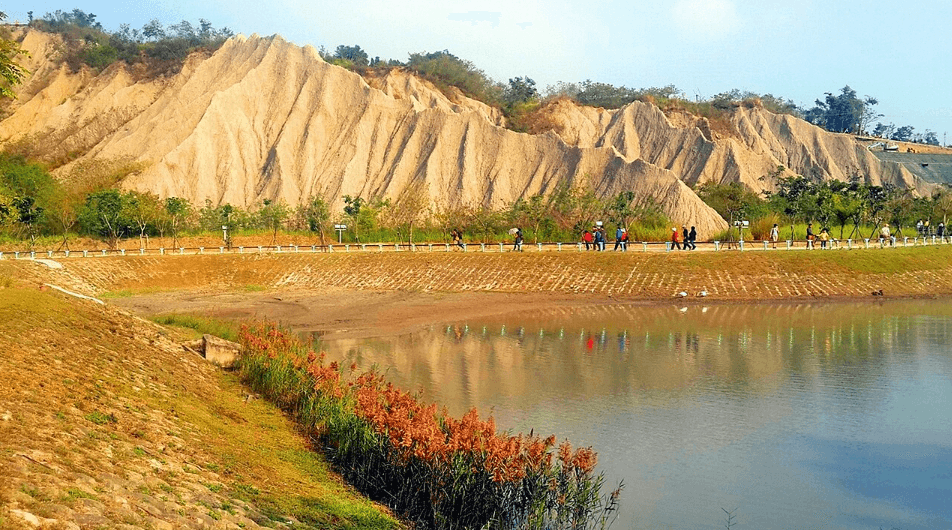
Tianliao Moon World is one of the most otherworldly natural landscapes in Taiwan, a vast expanse of eroded gray mudstone badlands that looks, quite literally, like the surface of the moon. The area is part of a larger geological zone shaped by millions of years of erosion and the unusual composition of the underlying mudstone, which is rich in salt and clay and supports almost no vegetation, creating an eerie, undulating landscape of rounded gray hills and narrow gullies as far as the eye can see. More than 20 mud volcanoes dot the surrounding area, gently bubbling and oozing in a way that adds to the strange, prehistoric atmosphere. A network of elevated walkways and observation platforms at the Tianliao Moon World Scenic Area lets you explore the terrain without disturbing it.
20. Kaohsiung Museum of Fine Arts

Address: No. 80, Meishuguan Road, Gushan District, Kaohsiung City 804 (accessible via YouBike or taxi from Zuoying or Sizihwan area)
The Kaohsiung Museum of Fine Arts is one of the finest contemporary art museums in southern Taiwan and a genuinely rewarding destination for anyone with even a passing interest in modern and contemporary Taiwanese art. Set within a beautiful 30-hectare park in the Gushan District, the museum’s collection spans painting, sculpture, installation art, ceramics, and digital media, with a strong emphasis on southern Taiwanese artists and themes connected to the city’s port identity, multicultural heritage, and relationship with the sea. The permanent collection is excellent, and the rotating special exhibitions frequently bring in significant international contemporary works as well. The surrounding sculpture garden and park are free to wander and lovely in the late afternoon light, making the whole complex a relaxed and pleasurable afternoon destination. Entry is affordable and the museum is closed on Mondays.
Kaohsiung does not demand your attention the way Taipei does. It does not announce itself with iconic skyline landmarks or the relentless buzz of a capital city. Instead, it pulls you in slowly and deliberately with the smell of grilled seafood drifting from a harbor-side stall, with the surprise of a world-class art installation tucked inside a subway station, with the view from a hillside temple looking out over a harbor that has been moving ships and stories for centuries.
The top tourist spots in Kaohsiung that you just read about are the foundation of a great trip, but the real magic of this city lives in the moments between them. The unhurried afternoons cycling along the waterfront. The accidental discovery of a tiny temple festival on a side street. The bowl of milkfish soup at a hole-in-the-wall restaurant that turns out to be the best thing you eat in Taiwan.
Give Kaohsiung two full days at minimum and if it starts to feel like that is not enough, you will know you have found your kind of city.
Ready to explore southern Taiwan’s finest city? Save this guide, share it with your travel group, and start planning your Kaohsiung adventure today!
Leave a Reply