
Quezon City is the largest city in Metro Manila, and its churches reflect that scale. From a Dominican shrine that has been rebuilt six times since 1587, to a circular UP campus chapel that five National Artists helped create, to a shrine built in thanksgiving for the peaceful revolution that changed the country in 1986, the beautiful churches in Quezon City span centuries, architectural movements, and stories that go well beyond the walls of any single building. Because QC has more than enough parishes for a full 14-church Visita Iglesia route, this guide covers all 14 stops in one day. Give yourself an early start and plan your route by area to keep travel time manageable.
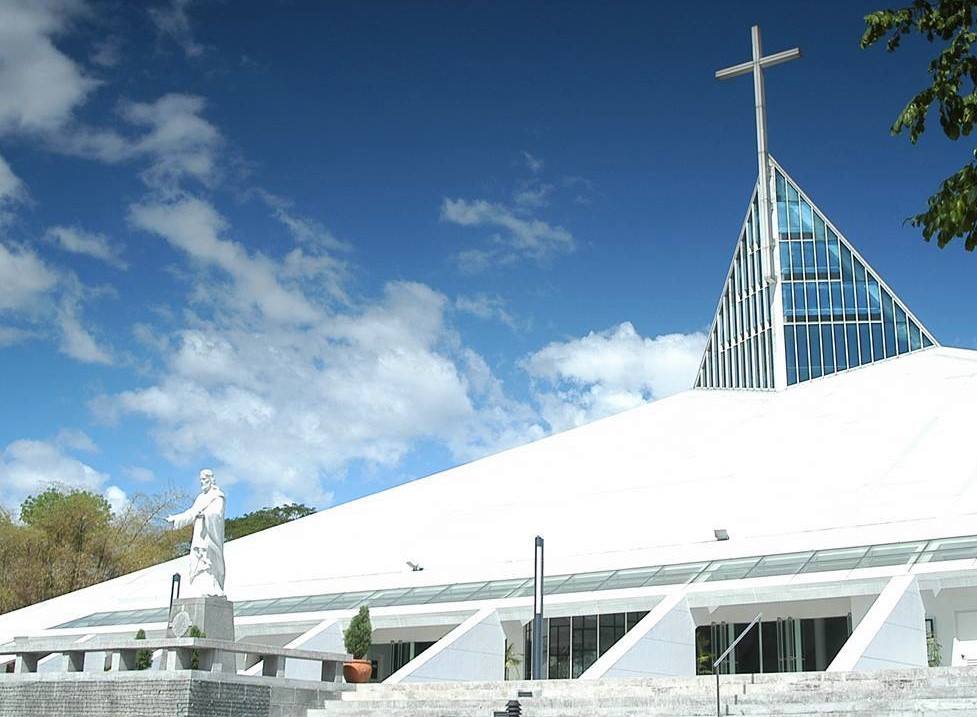
Church of the Gesù (Ateneo de Manila University)
Katipunan Ave., Ateneo de Manila Campus, Loyola Heights, Quezon City Facebook
The Church of the Gesù sits on Sacred Heart Hill, believed to be the highest point in Barangay Loyola Heights, overlooking Bellarmine Field on the Ateneo de Manila University campus. Designed by Jose Pedro Recio and Carmelo Casas, the massive triangular structure was built to represent the Holy Trinity, the three-fold mission of the school, and the outstretched arms of the Sacred Heart. It also draws from the form of the traditional Filipino bahay kubo. The cornerstone was blessed on September 30, 2001, and Cardinal Jaime Sin dedicated the church on July 31, 2002, with former President Corazon Aquino among those in attendance. One of its most talked-about features is the crucifix above the main altar, which depicts Jesus still alive and looking upward toward God, a deliberate departure from the more common image of Christ with head bowed in death. A 23-bell carillon donated by alumni chimes at 6 AM and 12 noon daily. The church has a side chapel for the Immaculate Conception and another for the Sacred Heart of Jesus.
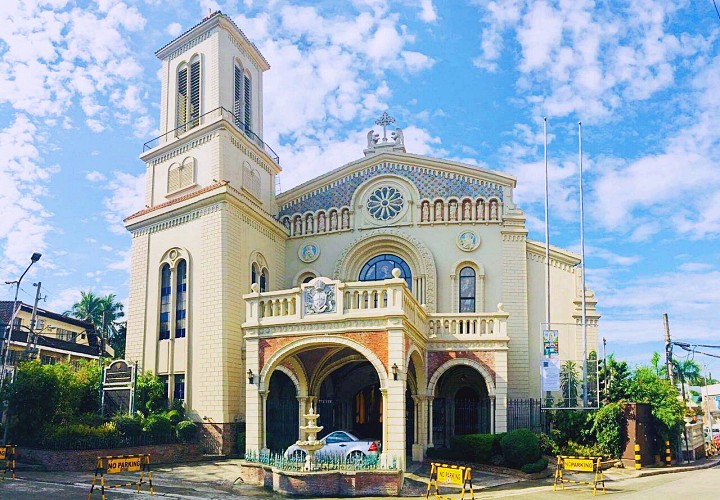
Immaculate Conception Cathedral (Cubao Cathedral)
40 Lantana St., Cubao, Quezon City Facebook
Where rice paddies once stretched across Cubao, the Immaculate Conception Cathedral now stands as the seat of the Diocese of Cubao. The story begins in 1935 when a small chapel dedicated to San Isidro Labrador was built on those fields, administered by the Society of the Divine Word. On December 8, 1949, the patron was changed to Our Lady of the Immaculate Conception, and on July 15, 1950, it was canonically erected as a parish. The Diocese of Cubao was established on June 28, 2003, and this church became its cathedral. The stained glass windows depict key moments in the life of Mary, including the Annunciation, the Assumption, and the image of Our Lady of Pentecost.
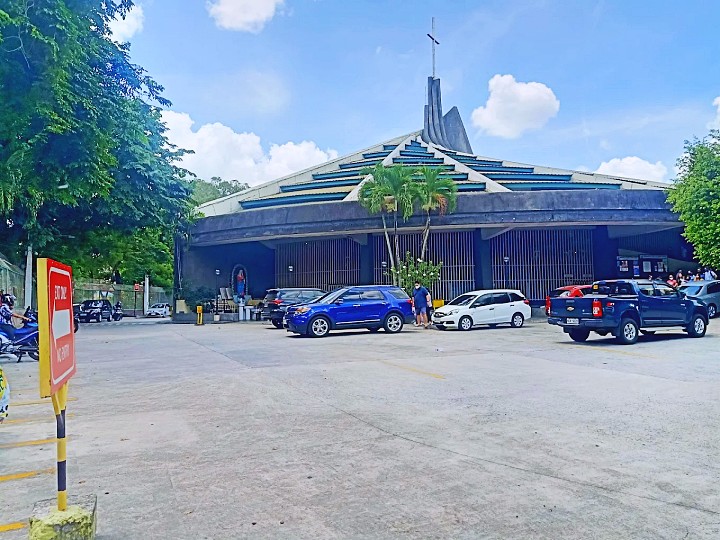
Immaculate Heart of Mary Parish
2 Mahinhin St., Diliman, Quezon City Facebook
The Immaculate Heart of Mary Parish is the only Claretian-run parish in all of Luzon, and it carries that distinction with a quiet but meaningful identity. Founded as a separate parish in 1969, the present church building was erected in 1972. On July 30, 2019, the National Commission for Culture and the Arts declared it an Important Cultural Property, a recognition that honors both its architectural and community significance.

Mary Queen of Peace Shrine (EDSA Shrine)
EDSA corner Ortigas Ave., Ortigas Center, Quezon City Facebook
No list of beautiful churches in Quezon City is complete without the EDSA Shrine. The idea came to Cardinal Jaime Sin just two days after Ferdinand Marcos fled to Hawaii in 1986. Passing the corner of EDSA and Ortigas with then-Auxiliary Bishop Gabriel Reyes, he saw the exact intersection where nuns and civilians had stood before tanks offering flowers to soldiers. Two billboards of the Family Rosary Crusade with an image of the Blessed Virgin Mary had stood on that empty lot. The land was donated by the Ortigas and Gokongwei families, and Architect Francisco Mañosa designed the shrine with openness and movement in mind, evoking the spirit of the People Power Revolution. The bronze image of Our Lady Queen of Peace at the apex was sculpted by the late Virginia Ty-Navarro. Inside the main chapel, a floating glass sculpture of the Risen Christ by Ramon Orlina faces the marble altar by National Artist Napoleon Abueva, who also rendered the 14 Stations of the Cross in bronze along the promenade. Upper wall murals depicting the four-day revolution were painted by 15 artists from Angono, Rizal. The stained glass ceiling above the main altar was designed by Eduardo Castrillo. The shrine was formally consecrated on December 15, 1989, just days after a failed coup attempt that had forced a postponement of the original December 8 inauguration date. This church carries a history that every Filipino should know.
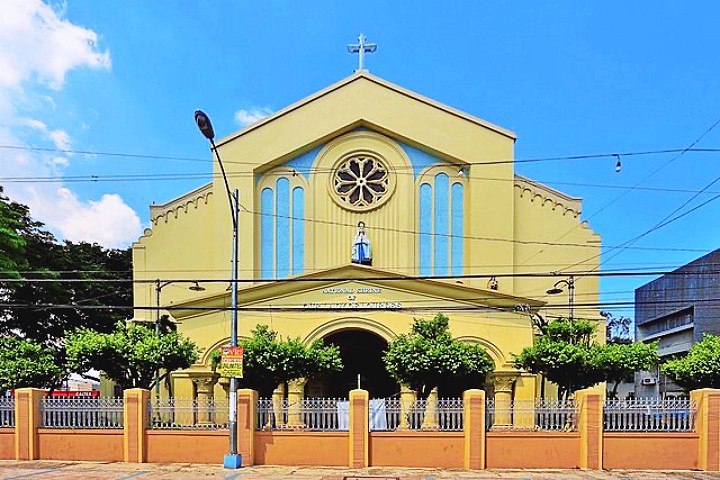
National Shrine of Our Lady of Lourdes
N.S. Amoranto Sr. St., Santa Mesa Heights, Quezon City Facebook
The venerated image enshrined here, La Venerada Imagen de Nuestra Señora de Lourdes de Manila, has survived wars, bombardments, and relocations since 1896. The original church stood in Intramuros until World War II destroyed it. Both Marian images were hidden in the sacristy of San Agustín Church in February 1945 before the fighting reached them. After the war, they were moved temporarily to the Santísimo Rosario Chapel at the University of Santo Tomas, then to a chapel on Mayon Street in Quezon City. On February 10, 1951, the images were transferred to this new church, which was formally consecrated on August 15 of that year. One of the most memorable stories connected to the shrine dates to 1896, when Doña Martina Azucena, diagnosed with a lung tumor and given no hope by doctors, prayed before the Venerada for one hour and walked out of the church with her strength restored. She had consumed nothing but Lourdes water for 28 days prior. Pope Francis granted a decree of canonical coronation for the image on September 5, 2019, and the image was crowned on August 22, 2020.
Minor Basilica and National Shrine of Our Lady of Mount Carmel
90 4th St., New Manila, Quezon City Facebook
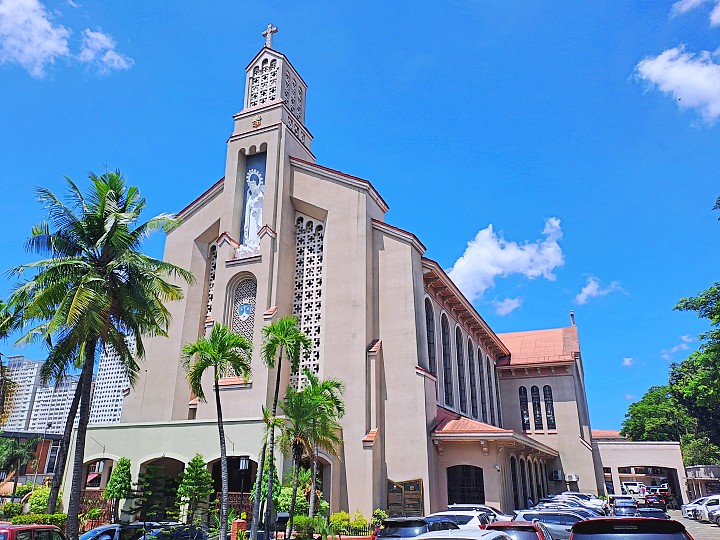
Irish Carmelite friars chose a cogon grass field on Broadway Avenue in New Manila in 1954 to build this church, on land that was part of Hacienda de Magdalena. The cornerstone was blessed on December 30, 1954, and it took a full decade to complete, with the inauguration taking place on July 16, 1964, the feast day of Our Lady of Mount Carmel, led by Cardinal Rufino Santos. In 2015 it was declared a national shrine, and on March 25, 2019, the Holy See elevated it to the rank of Minor Basilica, the first church in the Diocese of Cubao to receive that status. In 2024 it was further declared a cathedral. The venerated image of Our Lady of Mount Carmel, sculpted by master craftsman Maximo Vicente Sr., received its episcopal coronation on February 20, 2017, and its canonical coronation on August 15, 2020, approved by Pope Francis on the feast of Our Lady of Fatima. The stained glass windows trace the life of the Virgin Mary from her early life to her Assumption. A special bond of spiritual affinity with the Papal Basilica of Saint Mary Major in Rome was granted in February 2017, along with plenary indulgences for pilgrims in perpetuity.
Our Lady of Consolation Parish
81 Alondras St., Mira-Nila Homes, Congressional Extension, Quezon City Facebook
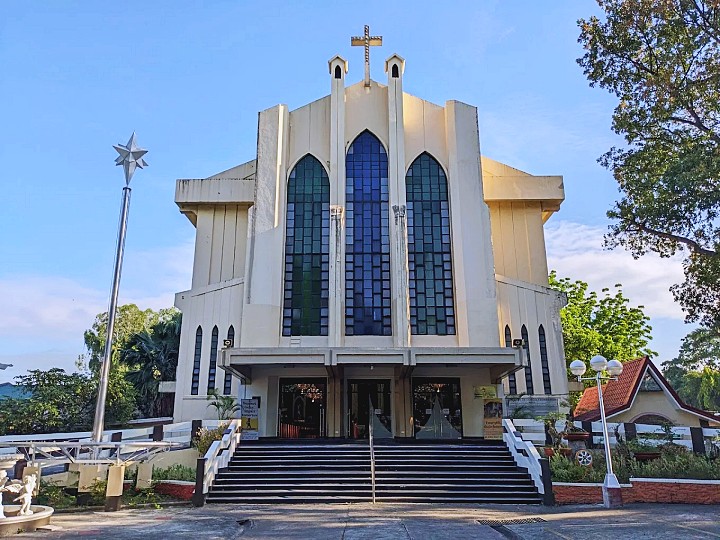
Established in 1987 and run by the Order of Augustinian Recollects under the Diocese of Novaliches, Our Lady of Consolation Parish serves the Mira-Nila Homes community in Quezon City. The church is known for its architectural design and its role as a center of Augustinian spirituality.
Parish of the Hearts of Jesus and Mary (Twin Hearts Church)
Daily Mirror St., West Triangle, Quezon City Facebook
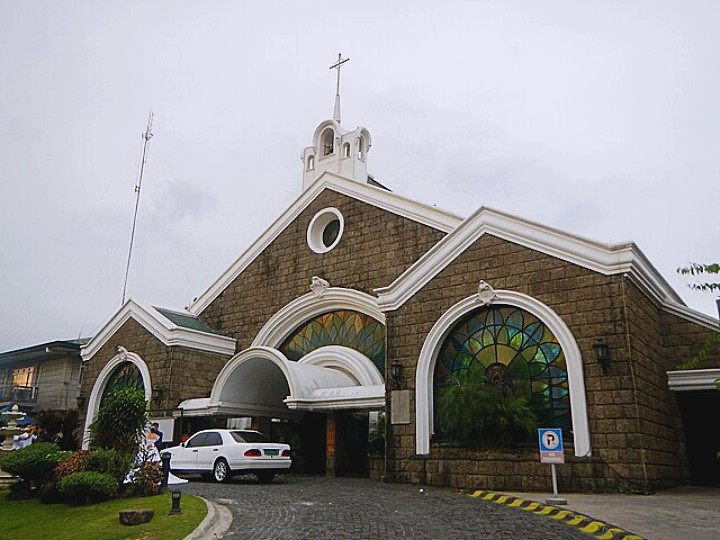
Known as the Twin Hearts Church, this parish in West Triangle, Quezon City draws attention for its gray stone brick exterior, triangular roofs, and colored windows. The brick driveway leads to heavy dark wood double doors, and a working fountain sits adjacent to the main entrance. Inside, marble floors lead to the altar, which is flanked by four grand gray pillars. An opening above the altar draws light directly onto the figure of Christ on the cross. The Chapel of the Nativity community was established as a new parish by Cardinal Jaime Sin on February 27, 1988, and renamed the Parish of the Hearts of Jesus and Mary.

Parish of the Holy Sacrifice (UP Chapel)
Apacible St., Diliman, Quezon City Facebook
The UP Chapel is one of the most architecturally significant beautiful churches in Quezon City, and arguably one of the most important church buildings in the Philippines. Designed by National Artist Leandro Locsin, it was the first circular church in the country with the altar at its center, and the first to use a thin shell concrete dome. The dome spans 29.26 meters, supported by 32 columns, and a circular skylight at the top supports the triangular bell tower from which the crucifix hangs. Locsin chose the round plan so the entire congregation could feel present at the Mass, rather than watching from a distance. The 15 murals depicting the Stations of the Cross along the circular walls are by National Artist Vicente Manansala, assisted by Ang Kiukok. National Artist Napoleon Abueva crafted the cross depicting both a suffering and a risen Christ, as well as the marble altar. The floor mural, called the River of Life, radiates from the altar in terrazzo, executed by National Artist Arturo Luz. The first Mass was celebrated here on December 21, 1955, by Archbishop Rufino Santos. The church was elevated to a parish by Cardinal Jaime Sin on May 30, 1977, and declared a National Historical Landmark and Cultural Treasure in January 2005.
Sacred Heart of Jesus Parish-Shrine
28 Scout Ybardolaza St., Kamuning, Quezon City Facebook
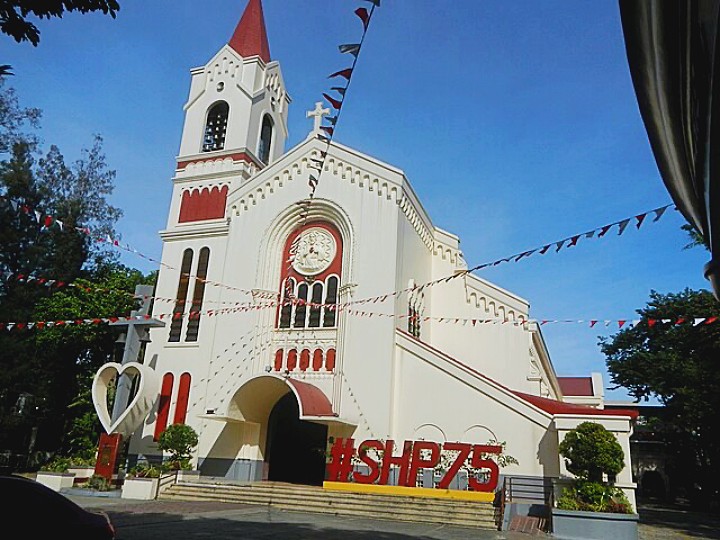
The Sacred Heart Parish-Shrine shares its founding story with the founding of Quezon City itself. In 1939, Commonwealth President Manuel Quezon looked out from a hill on what is now Tomas Morato Avenue and envisioned a Filipino metropolis. By year’s end, around 500 families had moved into Kamuning, a community with no church, no market, no school. The first Mass in the area was held outdoors on Christmas Eve 1940 at the Christ the King Seminary, with the rector of the SVD seminary presiding. On July 1, 1941, Archbishop O’Doherty laid the cornerstone, and on October 3 of the same year, the church was officially declared a parish under the title Parroquia del Sagrado Corazon de Jesus. On October 1, 2016, Bishop Honesto Ongtioco of the Diocese of Cubao declared it a diocesan shrine, granting a partial indulgence to the faithful who visit on the shrine’s liturgical feast day. Today it serves five barangays: Sacred Heart, Kamuning, South Triangle, Obrero, and Kristong-Hari.
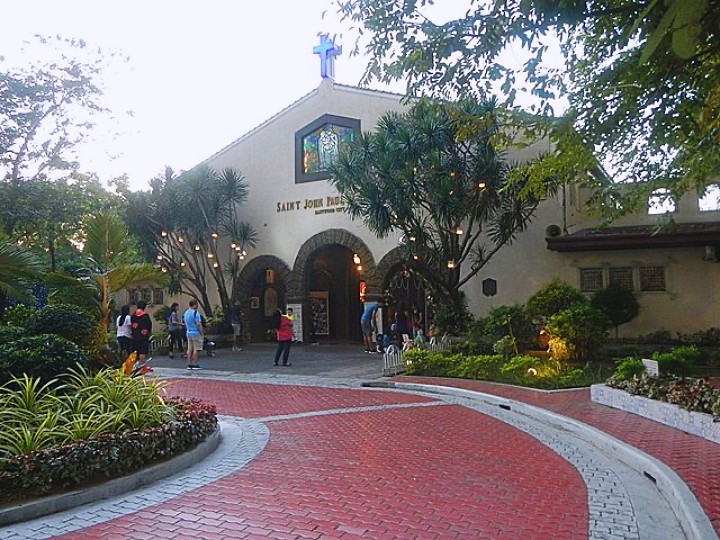
Saint John Paul II Parish
Orchard Rd., Eastwood City, Bagumbayan, Quezon City Facebook
Formerly known as the Holy Family Chapel, Saint John Paul II Parish was established in 2012 in Eastwood City and belongs to the Diocese of Cubao. The church exterior is understated gray, with its identity carried through three interconnected entrance arches and its iconography. Inside, the cream marble floors lead to a three-panel altarpiece with a wooden altar, giving the space a warm and intimate feel despite its urban setting.
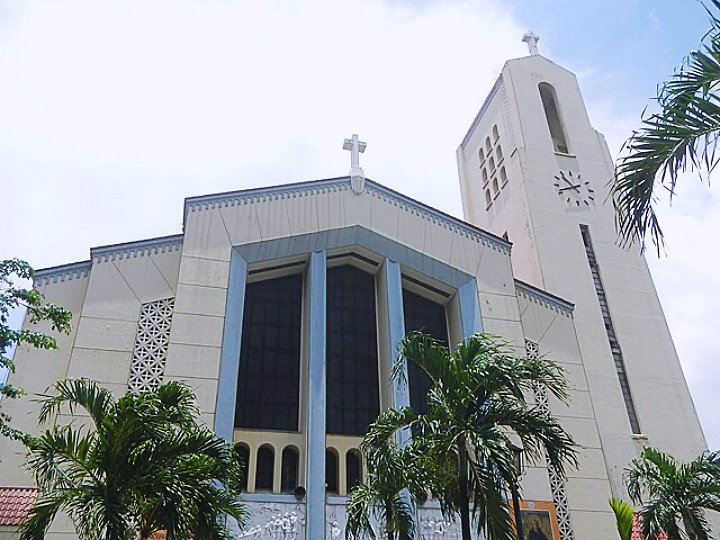
Santo Domingo Parish (National Shrine of Our Lady of the Holy Rosary of La Naval de Manila)
537 Quezon Ave., Quezon City Facebook
Santo Domingo Church has been rebuilt six times since the Dominicans first erected a church in Intramuros in 1587. Fire, earthquakes, the British occupation, and World War II each took their turn destroying what came before. The sixth and current church was built on Quezon Avenue after the war, designed by José María Zaragoza while he was still an architecture student at UST. Construction began in 1952 and was inaugurated on October 12, 1954. The icon of Our Lady of La Naval de Manila, the oldest Philippine-made ivory Marian icon in the country, was brought here from UST in a procession in 1957. The church is built in Art Deco combined with Spanish Modern style, measuring 85 by 40 meters, and is considered the biggest church in Metro Manila. Eight colorful murals by National Artist Carlos Francisco line the nave, depicting the life of Santo Domingo de Guzmán. The stained glass windows by Galo Ocampo depict the 15 Mysteries of the Holy Rosary and the Battles of Lepanto and La Naval de Manila. A nearly century-old pipe organ crafted in Hong Kong by Fray Gregorio Hontomin sits in the choir loft. The church was declared a National Cultural Treasure in 2012, the first in Quezon City to receive that designation. A secret vault on the grounds holds centuries of ivory icons, gem-studded crowns, and Marian robes. The Museo de Santo Domingo and Café Inggo 1587, a Spanish-Filipino restaurant on the southwest corner of the complex, are also worth your time.

Santuario de San Vicente de Paul Parish
221 Tandang Sora Ave., Tandang Sora, Quezon City Facebook
Completed in 2012 and designed by multi-awarded architect Froilan Hong, the Santuario de San Vicente de Paul is one of the most artistically deliberate and beautiful churches in Quezon City. The footprint of the church is shaped like a kite, and the interior uses lines that radiate from the altar ceiling, with wide windows that draw in natural light throughout the day. The crucifix above the altar, entitled “The Last Two Minutes of Christ” by sculptor Jordan Mendoza, shows Jesus looking downward as if addressing someone, with his right hand pointing outward. The altar table by Daniel dela Cruz translates the Resurrection through a bare surface draped with a piece of bronze lace representing the burial linen left in the empty tomb. The massive bronze church door by Michael Cacnio depicts the Ascension of Christ in a stylized composition. The Adoration Chapel houses an ornate Baroque retablo carved by Willy Layug, dedicated to the Miraculous Medal and drawn directly from the elements Mary presented to Saint Catherine Labouré in 1830. Every piece of art in this church was commissioned with a specific theological intent.
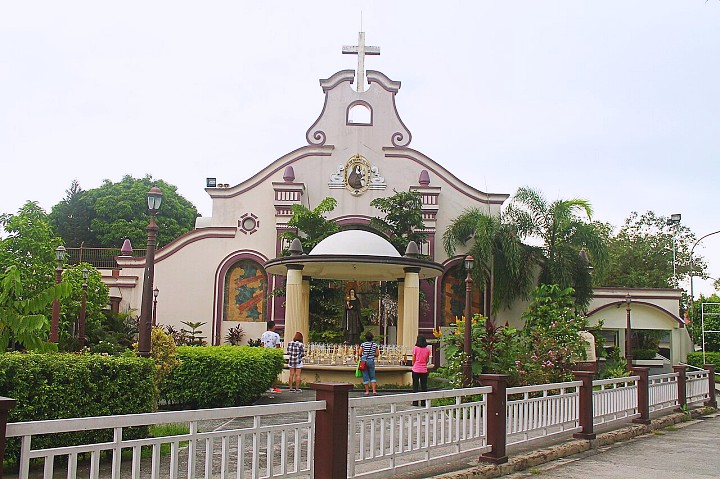
St. Clare Monastery
Katipunan Ave., Quezon City Facebook
The Clarisas have been on Katipunan Avenue since 1950, when an American owner donated his house to the nuns after their original Monasterio de Santa Clara in Intramuros was destroyed in World War II. They lived and prayed there for five decades until the 1990s, when the C-5 highway construction was rerouted through the monastery property rather than through the land of a well-known businessman. The same businessman then donated a property on the other side of the old convent and built a new monastery for the nuns. They have been in that new convent ever since, receiving devotees who come to pray in the quiet that a cloistered community holds.
Explore More Beautiful Churches in Metro Manila
Your Visita Iglesia journey doesn’t stop here. We’ve put together city-by-city guides to help you plan your Holy Week route across Metro Manila, one church at a time.
See All Beautiful Churches Here
Leave a Reply